Wednesday, December 18, 2019

Christmas Break---all students have study guide and answers are up until January 6th.


Well, it has happened. .  We are out for a long Christmas break and Mrs. Olsen is home with the two cats, two rabbits and two dogs that occupy her house.


We have been learning about the Progressive Era in Social Studies 9, and part of that Era was the formation of the Humane Society in 1866.  Earlier animal societies had been formed in Europe, but now Americans joined groups that were concerned about the treatment of animals:  including domestic pets and livestock and transportation animals.  Here is a picture of the Dorothea Dix Fountain in Boston that was created for horses to drink out of.  Dorothea Dix was a popular supporter of animal rights, but she is best known for her pioneering work with the mentally ill.

Mrs. Olsen shares her home with Joey and Bumbles.  They are not owned by her, but they live with her, and actually just kind of tolerate her.

The most famous cat was Petrarch's cat.  Petrarch was an Italian poet, who was very attached to his cat.  He actually wrote a poem to his cat, which has made that cat very famous.  It was even put on a tomb.  Mrs. Olsen did grow up in Salem, but her family dogs are buried out at the family farm near Turner.  It makes her sad to think of her animals that have passed on, but happy to think they can hear the calls of the Canadian Geese in the fall as they fly over their final resting place.  Many students also have animals and have adopted them from Humane Societies.  Mrs. Olsen's two dogs are rescues.

Tuesday, November 26, 2019

Jane Addams Maps of the area around Hull House Chicago

When Jane Addams, a single woman in Chicago, bought a large empty house in Chicago's immigrant area, she had big plans.  She was copying the settlement house movement that began in England.  In a crowded slum area called Toynbee Hall, social progressives created a community center that offered health care, cultural activities, and social supports for the poor.

Miss Addams bought Hull house, and soon, other homes were bought in the area.  Around the Hull House neighborhood were crowded tenements, that might be called slums by today's standards.  The Hull House/Settlement House movement grew to over 400 settlement houses.  They were called this for a simple reason:  They helped people get "SETTLED" into their new life in the United States.
When I visited Chicago, I went to Hull House and obtained copies of the maps that she had made of the people around the surrounding neighborhood.   All the maps were color coded according to the background of the persons.   The maps told some interesting things:  the Irish lived by the Italians as they were both Catholic.   The Polish lived by the Russians as they were neighbors in Europe. 

Because many of the tenements had their occupants move out--only to be replaced by the same ethnic group, she invested the money to have the maps made up in so much detail.  The maps are not just a valuable clue to the vibrant mix of immigrants in America---they also reveal the concern that Miss Adams had that she know all her neighbors and their needs.

In 1931, Jane Addams, a social worker, was awarded the highest award:  The Nobel Peace Prize.  This tremendous honor was criticized by some, for she was just considered a social worker.   The Nobel Committee knew better.  Jane Addams would be one of the great humanitarians of the 19th century.

Monday, November 4, 2019

Veteran's Day November 11th

Veteran's Day--Remembrance Day


After teaching in Canada for 20 years, I came back and experienced my first American Veteran's day. Though I was born in Salem and attended Sprague, when I lived in Canada this was a day that was honored with respect and reverence.

For example, in almost every Canadian school there was an assembly about war and peace.

Almost everyone wore a fabric poppy to honor the soldiers who fell in the war. The Flanders poppies grew prolifically over the graves in the years just after the war. Of course, another Canadian also wrote the poem "In Flander's Fields."

The Canadians were also very proud of their victory along the Arras line in 1917 April 9th. This was the Battle of Vimy Ridge. I have been to the battlefield twice, and it is preserved as a park because the land was given to Canada for a memorial by France to honor the men who died there. Driving in the area of the Western Front is a bit sad, for just as there are fields of grain, there are also fields of graves. The Canadian graves have maple leafs on them. The memorial to the fallen soldiers is considered one of the most beautiful, if not the most beautiful of all the foreign monuments along the Western Front. The park still has the trenches and shell holes that are now covered in grass. A small flock of sheep is used to trim the grass as the undulations make it difficult for a traditional lawn mower.

In Salem, Oregon we even have Civil War veterans buried in our two pioneer cemeteries.    We have a memorial to the medal of honor  recipients, and we also have a World War II memorial and a World War II memiorial.

Monday, September 23, 2019

The Agriculture Revolution and Norman Borlaug.


In 9th grade history, we have learned a bit about the Agricultural Revolution of the 1700's which helped boost food production. Farmers used science to improve crop and livestock production. With more food available, people could plan to have families. As the population increased the demand for products grew, and this demand led to the inventiveness and expansion of the Industrial Revolution.
Who has saved more human lives than anyone else in history? Who won the Nobel Peace Prize in 1970?
Norman Borlaug is responsible for much of the progress humanity has made against hunger.  He was an outspoken advocated for the green revolution.   He also had some things to say about organic food.  Here is a quote:   If people want to believe that the organic food has better nutritive value, it's up to them to make that decision. .If some consumers believe that it's better from the point of view of their health to have organic food, God bless them. Let them buy it. Let them pay a bit more. It's a free society. But don't tell the world that we can feed the present population without chemical fertilizer.

Wednesday, August 28, 2019

Welcome new Freshmen, and welcome back Sophomores.....

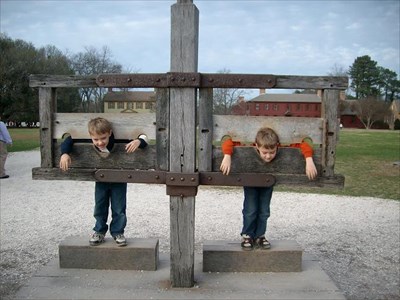
Weclome, Freshman students, to Sprague High School, and welcome back Sophomores.  I look forward to a great year studying history with you. You might feel like these young kids that are posing in the stocks at Colonial Williamsburg, but be honest, you are happy to be at school. Right?

I hope you all had a great summer.  Mrs. Olsen did some projects, as usual.  She built a fence, tiled her front entry way and watched the plumber take out and replace her sink.  She also trimmed two million bamboo shoots in her back yard.  She also taught the Freshman academy so some of you may have met her already.  She is a graduate of Sprague High School and enjoyed looking at the old yearbooks with you.

She also traveled back East and studied some American History with other teachers from across the United States.  She learned a lot about early American History at Colonial Williamsburg, Virginia.  One night, she was nearly mugged when she walked back to her hotel on a secluded path.  She outran her attacker instead of beating him off with her handbag.   The incident was captured on video.  When she asked the police officer if she looked "ok" while she ran away,  he didn't say anything.  She asked the officer  if she looked like she could try out for an Avenger film, and again he didn't say anything.  Well, I guess that answers why she's back at school teaching both 9th and 10th grade history.

Friday, June 14, 2019

Have a great summer!

Hope all my students have a nice summer in beautiful Oregon.  Thanks for being such a nice group of students.  It was a pleasure to have you in class.

This summer, Mrs. Olsen will be traveling  and going to Colonial Williamsburg with other teachers to learn about American History.    She hopes that she will learn some more tips about teaching and looks forward to meeting with teachers from across the country. Colonial Williamsburg is a "real" town that closely resembles the way that early Americans lived during the time of the 13 colonies, in the 1700s.   She also hopes to go out to Jamestown and up to Yorktown.  

She will also spend the summer with her dogs, Winslow and Sophie.  Of course, the two cats Joey and Bumbles will only spend time with her if they feel like it.  Most of the time, they will ignore her.


Tuesday, May 14, 2019

Leaving the Depression---onto World War II

WEDNESDAY, MAY 4, 2011


President Herbert Hoover (1874-1964) was raised in Oregon after his parents died. He is well-known as the president who presided over the first 3 years of the Great Depression. Hoover flags and Hoovervilles and Hoover blankets were all part of the popular criticisms of President Hoover.

However, Hoover had another reputation--and that was "Master of Emergencies." During the years after World War I, Hoover saved the lives of millions by overseeing the Belgium and Russian food relief program. When asked if he was not thus helping Bolshevism, Hoover retorted, "Twenty million people are starving. Whatever their politics, they shall be fed!" His engineering background helped him oversee an unprecedented movement of food supplies to help people whose lives hung in the balance.

As part of a thank-you, Belgium women took the flour sacks and returned them to the United States, filled with beautiful embroidery, and yes, Belgium lace at the edges.

Years later, after World War II, President Hover was again called out of retirement. Even though President Truman was told to not have anything to do with Hoover, Truman invited Hoover to the White House and asked him to lead the relief effort. Again, President Hoover traveled the world tirelessly helping with food distribution to starving millions.